Inside the Outdoors is a unique and hands-on environmental education program serving over 120,000 participants per school year. Its mission is to empower students, teachers, parents and the community to explore natural areas and expand their knowledge, understanding, and stewardship of the environment through their Field Trips, Traveling Scientist, and Community programs.
The curriculum created for their programs supports current California academic standards and allows students to interact with these concepts in a real world setting. Inside the Outdoors has been a leader in hands-on science and social science programs since 1974, is administered by the Orange County Department of Education, and is a self-supporting program.
Inside the Outdoors offers programs for students of all ages that Nurture a Natural Curiosity. Their Preschool/TK programs provide a hands-on opportunity for students in preschool to develop an awareness and appreciation of the sciences through the exploration of the animal kingdom. In addition, the program fosters a commitment to the protection and understanding of the environment and community.
The Traveling Scientist programs are designed for each grade level, Kindergarten through high school. For example, students in the 2nd grade study habitats while students in the 5th grade study food webs. Middle school students may study sensory structures in animals, investigate microorganisms in wastewater, or the impacts of human land uses on watersheds. High school students may study renewable energy or sea level rise
Inside the Outdoors also offers Traveling Scientist programs for the Expanded Learning Opportunity Program such as Amazing Animals, Renewable Energy, and Rethink Resources. In addition to the Traveling Scientist Program, students may also participate in Field Trips at various locations around Orange County including Shipley Nature Center, Wild Wetlands, Crystal Cove, or Irvine Regional Park. All of their programs are designed to be hands-on and provide an opportunity to engage with the natural world.
With the school year coming to a close, Inside the Outdoors is preparing for Summer Day Camp 2026 at Shipley Nature Center. Children experience unique activities that incorporate science, fun, learning, and being outdoors. Summer Day Camp is geared toward campers age 6 to 12 years old, with leadership and camp opportunities for campers age 13-17. Each week of summer camp will have themed daily activities that are science/nature based that also include a daily nature journal prompt and a take-home craft.
Inside the Outdoors also designed some Community Programs and Virtual Programs to meet the wide range of needs of the community. For more information about Inside the Outdoors programs, call 714-708-3885 or email insidetheoutdoors@ocde.us.
The mission of the San Francisco Zoo & Gardens is to connect people with wildlife, inspire caring for nature and advance conservation action. The San Francisco Zoo is designed with the underlying belief that nature-focused interaction leads to conservation action. Learning about animals here inspires visitors to care for all wildlife.
Nestled against the Pacific Ocean, the San Francisco Zoo is an urban oasis. It is home to over 2,000 exotic, endangered and rescued animals representing more than 250 species and lovely peaceful gardens full of native and foreign plants and is open 365 days a year
The majestic Leanne Roberts African Region and the Valentine Family Savanna offer a multi-species landscape with giraffes, zebras, kudu, ostriches, storks, and more. At Hearst Grizzly Gulch, visitors can get nose-to-nose with rescued grizzly sisters Kachina and Kiona. Lemurs leap through the Lipman Family Lemur Forest, the largest outdoor lemur habitat in the country. Penguin Island is home to the largest colony of Magellanic penguins outside of the wild. The Zoo’s troop of gorillas lives in the lush Jones Family Gorilla Preserve. Farm animals for feeding and petting can be found in the popular Fisher Family Children’s Zoo. The historic 1921 Dentzel Carousel and the 1904 miniature Little Puffer steam train are treasured by generations of visitors. And the reimagined Elinor Friend Playground offers accessible playtime for all ages. The SF Zoo offers an engaging experience for its guests, including fun rides, educational programs and exciting events throughout the year. The SF Zoo is proud to be accredited by the Association of Zoos and Aquariums (AZA).
The evolution of the San Francisco Zoo into what we know today has been one of steady progress towards a primary mission of conservation. The San Francisco Zoological Society’s highest priorities are providing quality animal care, advancing wildlife conservation, and educating visitors about nature by connecting them with animals. They hope to inspire their guests to connect with wildlife by creating naturalistic new habitats, renovating older exhibits, providing animals with a vast array of stimuli and behavioral enrichment opportunities, and presenting unique opportunities through which to experience nature.
SF Zoo offers a variety of educational programs for different age groups and levels. School field trips are offered between the months of September through May, with classroom teachers and chaperones in attendance. SFUSD school field trips are free and with discounted rates available for non-SFUSD schools. The Zoo website has fun, science-based activities that can be used as pre-visit lessons to build student excitement prior to the field trip.
With programs like Little Learners and Zoo Camp, there’s so much for your little one to learn! Zoo Camp is a week-long program (M-F) that focuses on conservation, animal activism and hands-on art and science. Camp families can sign up for 1 or 2 weeks of animal/habitat exploration and wildlife fun with the team at SF Zoo and Gardens!
Teacher Resources: Whether you need to prepare your students for a Zoo field trip or need an activity for your homeschooler, they have you covered. Designed to enhance lessons in biology, zoology, and ecology, these resources will help connect your learners to wildlife. The Zoo has prepared Exhibit Exploration Guides to offer suggestions on how to interpret various life science topics while viewing the exhibit. Find out how you can talk about habitats, adaptations, and animal behavior while enjoying the sights and sounds of animals in the exhibits. They also offer Zoo Vocabulary, Zoo Field Trip FAQs, and supplemental resources such as books and websites to explore.
The San Francisco Zoo also offers many volunteer opportunities for youth and adults. The Animal Rescue & Conservation Center (ARC) is a training ground for future ecologists, conservationists, biologists, zoologists, and animal care staff through its teen volunteer programs. The animal ambassadors play a key role in connecting their guests with wildlife. Youth ages 12-14 can become a Nature Trail Volunteer helping educate visitors. Youth ages 15-17 can become ARC Junior Zoologists and assist with animal husbandry or become Leadership Fellows helping with Zoo Camp and teaching younger children.
Adults can volunteer to become Docents. Docents support the Zoo’s mission by engaging guests in conservation education through informative talks, biofact presentations, and sharing the Zoo’s conservation initiatives while out at our exhibits. Speaking about the animals and their wild counterparts inspires their guests to celebrate their animal ambassadors, protect wildlife in their natural habitats, and engage in independent conservation action. Adult animal care volunteers offer support in the ARC, Children’s Zoo, or the Insect Zoo. The opportunities to get involved are numerous.
If you haven’t visited the San Francisco Zoo lately, or perhaps you’ve never visited, then you might consider an upcoming trip. Enjoy all the wonders the zoo offers!
Joshua Tree National Park was elevated to national park status in 1994 as a part of the Desert Protection Bill, having been designated the Joshua Tree National Monument since 1936. The bill added 234,000 acres which now stands at 792,623 acres, of which 591,624 is designated wilderness. Joshua Tree NP protects the unique assembly of natural resources brought together by the junction of three of California’s ecosystems: the Colorado Desert, the Mojave Desert, and the Little San Bernardino Mountains. The plant and animal diversity are unique along with some very interesting geologic features.
Joshua Tree NP provides the perfect outdoor setting to enhance classroom-based learning. You can visit on your own or have a ranger join you for an outdoor education program. All ranger-led education programs are curriculum-based (California State Education Standards, NGSS) and free of charge.
Field Trips: The Preschool and Kindergarten program is Who Lives in a National Park and explores the plants and animals who make the desert home. Early Elementary programs include Junior GeoKids and Exploring a Desert Habitat while the Upper Elementary programs include Geokids and Keys to the Past. Programs are also available for Middle and High School students and include Tune In to Tracking, Joshua Tree Monitoring, and Issues in Park Management. This brief video gives students tips on How to Prepare for Your Field Trip.
Virtual Field Trips: Educators anywhere can schedule a virtual field trip lasting 30-45 minutes. Teachers can choose from Plants and Animals, Draw JT, Geology of JT – Rocks and Minerals or Weathering and Erosion. These are offered free of charge and must be requested in advance. Virtual field trips support NGSS and are offered for all grades Preschool and Kindergarten through high school.
Guest Speakers: A ranger can visit your classroom to lead students activities relating their study of the sciences to Joshua Tree National Park! There are topics for all grade levels. Teachers should coordinate with each other to serve at least three classrooms during the ranger’s visit.
Joshua Tree NP provides curriculum resources and a number of lesson plans and activities for educators to use. The Joshua Tree NP staff also offers professional development workshops for teachers through the Desert Institute, the educational branch of the Joshua Tree NP Association. They offer a variety of field courses in natural science, cultural history, recreation, and the arts. Programs are taught by experienced instructors. Please see the Desert Institute’s website for their current schedule of classes.
The Joshua Tree NP offers children the opportunity to become a Junior Ranger. “Explore, Learn, Protect!” The Junior Ranger motto is recited by children around the country—each taking an oath of their own to protect parks, continue to learn about parks, and share their own ranger story with friends and family. Take a few minutes to learn more about the Joshua Tree National Park and all the services and experiences it offers. Spring is an amazing time to visit the desert!
The California Department of Fish and Wildlife offers a variety of educational and outreach programs for all ages and audiences in classrooms, at their hatcheries and visitor centers, on their lands, and online. Their programs cover topics such as coastal and marine education, climate change, environmental sustainability, land ecosystems, and watershed education.
The Classroom Aquarium Education Program (CAEP) is a hands-on, science-based education initiative for grades K-12. CAEP will improve teacher and student understanding, appreciation, and stewardship of fish populations and their ecosystems, while creating an awareness of the needs of the aquatic environment through the use of classroom aquaria. With the support of regionally based community organizations, students throughout California have the unique opportunity to hatch and raise Chinook salmon, steelhead trout, rainbow trout and and other salmonids in their classrooms, then release fry into nearby approved water bodies. CDFW, along with community partners, works to enhance classroom educational experiences through the hatching and raising of salmon, steelhead, and rainbow from the egg to the fry stage.
The CAEP website hosts a variety of teacher resources including webinars, videos, curriculum guides, field trip guides, posters, handouts and worksheets, and tank setup and care. The curriculum and program resources listed are recommended to assist CAEP teachers with concepts such as life cycles, aquatic habitats and watersheds, fish survival needs, climate change and human impacts. In addition to classroom resources, they encourage teachers to take their classes on visits to watersheds, rivers, streams, fish hatcheries, fish ladders, or habitat restoration projects to observe the concepts and practices learned through CAEP in action.
Join California Department of Fish and Wildlife interpreters and scientists for a deep dive into aquatic ecosystems and fish during this fun webinar series designed for early elementary school aged students. Teachers and students are encouraged to come prepared with questions to ask the scientists during the Q&A portion of this live program.
One Cool Earth is a non-profit organization with programs in San Luis Obispo and Santa Barbara Counties rooted in the belief that every child deserves a place to grow. They support lifelong wellness and environmental stewardship for families and youth from birth through young adulthood, cultivating a thriving, resilient community – one garden at a time. Their School Garden Program works with schools to champion garden education as a way of teaching students hands-on skills, science, nutrition, technology, and environmental literacy.
Using school garden spaces as living laboratories, they provide NGSS-aligned science, nutrition, and nature-focused education at SLO County public schools. The Garden Program offers two tiers for schools to choose from along with numerous add-ons, including garden lunch club, family cooking nights, seasonal farm stand, waste audits, summer garden care, and virtual or in-person field trips.
Play Grove is a garden-based enrichment program designed for 3-5 year olds located in San Luis Obispo at their central garden on Laureate Lane. As an extension of One Cool Earth’s seasoned learning model, they know that children grow best when learning outside through play. They are a nature-based and place-based enrichment program. This means they use the environment as a guide as they play, grow, create art, garden, and learn together. Play Grove allows young children to access this experience alongside enthusiastic playguides in a nature-based environment.
Since 2020, One Cool Earth has proudly partnered with Atascadero Unified School District (AUSD) to steward and grow the district’s 1.5-acre farm—a dynamic and educational space that serves both students and the broader school community. The AUSD farm is home to 60 thriving dwarf fruit trees, native pollinator gardens that support local biodiversity, and abundant growing beds and rows that produce seasonal fruits and vegetables. This year, they partnered with the local Resource Conservation District to plant over 100 natives onsite! Most of the harvest is integrated directly into school lunches through AUSD Food Services, providing students with fresh, hyper-local produce.
Each week, high school students engage in hands-on agricultural education through Career Technical Education (CTE) programming, working alongside their experienced farm manager. From planting and harvesting to soil building and crop processing, students gain valuable skills in sustainable agriculture, food systems, and environmental stewardship. They also offer elementary school farm field trips!
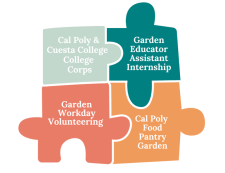
Brief nature experiences, even as short as 10 minutes, have been shown to significantly improve mood and reduce stress among college students. As part of their commitment to supporting youth through every stage of their educational journey, One Cool Earth’s College Mentorship Program provides meaningful opportunities for early adults to grow as leaders, educators, and changemakers. We partner with Cal Poly, Cuesta College, and other institutions to engage students studying environmental science, agriculture, child psychology, and education.
Through internships, volunteer events, and mentorship opportunities – including support for the Cal Poly Food Pantry Garden—college students gain hands-on experience while contributing to our mission. This program is a key part of their vertical integration strategy, fostering a lifelong connection to environmental stewardship and youth wellness. One Cool Earth also offers links to garden education resources for educators and parents plus other types of environmental education. Check out the One Cool Earth website to learn more.
Audubon Center at Debs Park is a community hub located in Montecito Heights, less than five miles from downtown Los Angeles. Nestled within the 282-acre Ernest E. Debs Regional Park, the center has inspired a love of nature in over a quarter of a million residents of Los Angeles. With sweeping views of northeast LA to downtown LA and more than 140 species of birds within the park, the center is an oasis of nature for urban communities. In its holistic, people-focused, approach to conservation work, the Audubon Center at Debs Park serves as a community hub for environmental justice and advocacy work in Los Angeles and across the Audubon network.
The center’s mission is to inspire people to experience, understand and care for the local natural world. Habitat restoration is one of the center’s core tenets as it not only provides habitat for birds, but also increases green spaces for urban communities that may not otherwise experience California native flora and fauna. Through the efforts of staff and volunteers, one can see how these conservation efforts have restored the landscape of Debs Park, bringing with it fresh scents and experiences. In addition to restoring habitat for birds and other wildlife at Debs Park and along the LA River, the center’s primary goal is restoring the connection between people and the land in Los Angeles.
As the first center that the National Audubon Society built within an urban environment to specifically engage the Latino community, the Audubon Center at Debs Park has played an important role in building a more diverse and inclusive conservation movement in Los Angeles and beyond. Whether it’s watching a movie outdoors underneath the Los Angeles night sky or beginner birders taking their first hike up the hills with rented binoculars in tow, the center’s belief is that everyone has not only the right to be in nature, but to know that they belong.
One of the other pillars of the center is community engagement, connecting birds, plants, and people together. Numerous events are held on a weekly basis, ranging from community habitat restorations to festivals celebrating winter. The center is honored to collaborate with the many wonderful community-based organizations and individuals in Northeast LA and to share their vision in green access and equity through community events and more. Not only is the center supported by volunteers and community partners, but it is also bolstered through interns and program participants.
In fostering the next generation of environmental stewards, the center runs the Audubon Youth Leaders program, where high school students learn habitat restoration, environmental advocacy, and community engagement. The center also hosts numerous interns from other organizations and programs, such as HIRE LA and California’s College for All Corps. In their time at the center, they will learn workplace skills, conservation skills, engagement skills, and more to help them be eco-conscious and confident in the ever-changing world.
The Audubon Center at Debs Park offers two types of field trips. The Self-guided field trips are not led by an Audubon Naturalist. Instead, they lend tools to groups to enhance their day in the park. The tools include binoculars, field guides to bird and native plants, and even art supplies. These are free as long as they are reserved in advance. The Audubon-led field trips are paid programs consisting of a guided tour and educational nature activities lasting about two hours. An Audubon Naturalist guides students on a nature walk followed by an engaging STEM nature activity that teaches them how ornithologists work with birds and nature.
The programs are best suited for 3rd to 4th grade students but they can be scaled up or down depending on the group. The center offers free community events year-round for students and the whole family. They offer beginner-focused bird walks, habitat restoration volunteer opportunities, festivals, community movie nights in the outdoors, music performances, and workshops and seminars. Visit the Audubon Center at Debs Park website for a list of the most common feathery friends you might expect to see at the park.
The Natural History Museum of Cal Poly Humboldt in Arcata offers a wide range of programs and activities. It is open to the general public and hosts standards aligned programs for schools. In addition to their in-museum exhibits which includes bees, birds, butterflies, coral and sponges, crabs, fossils, shell, and rocks and minerals, the museum also provides online exhibits that include the redwood forest, prehistoric animals, fossils, and plant history.
School visits to the museum allows K-12 students to discover their unique collection of fossils, rocks, and minerals, animal specimens, and interactive activities to supplement classroom lessons. Programs are designed to encourage scientific inquiry, and engage students in the natural world.
Kindergarten students learn to compare animal structures and adaptations. First graders focus on animal teeth and diet while second graders learn to classify minerals through observation of physical properties. Third graders study mammal fossils while fourth graders study rock types. Fifth graders learn about the flow of energy in a living system such as the redwood forest and sixth graders investigate plate tectonics and earthquakes. The museum offers other options for 7-12 grade students.
The Natural History Museum provides virtual programs for first through seventh graders. These programs include a 40-60 minute interactive virtual session with the class as well as activities for teachers to conduct with their students in advance. These programs are all aligned with NGSS standards. The Museum also offers a variety of Discovery Days with interactive hands-on activities for the whole family. Each Discovery Day has a theme including Rocks & Minerals, Anthropology, Zoology, and Astronomy. They recently held a Cool and Creepy Discovery Day. Summer Youth Camps are offered on a variety of topics. The camps include hands-on exploration, inquiry, arts integration, activities, and games. The camps are designed for ages 6-9 years.
Internship opportunities are available for Cal Poly Humboldt students. The museum staff works with Cal Poly Humboldt faculty to design internship experiences that meet the needs of the students and adds to the richness of the museum and community. Some internships are part of a class project while others are individual capstone projects for a major.
The museum offers a monthly Speaker Series that strives to offer thought-provoking and information evening lectures to the community at large with a wide variety of nature based topics from dinosaurs to dinoflagellates. Upcoming events include Favorite Fungi: Meet the Parasites & Slimes and Scientific Illustration. The museum also offers a number of rotating workshops that are hosted by local experts.
Teaching Boxes are available for teachers to check out from the museum for use in the classroom. They include hands-on materials and lesson plans and are designed to supplement curriculum through hands-on learning with the use of museum resources. Each teaching box contains accurate and up-to-date information on a particular topic, as well as specimens and materials that every student will be able to observe and/or touch. Each box contains a manual with factual information for background reading, developed experiential learning activities, and suggested extension activities. Current teaching boxes include birds, rocks and minerals, prehistoric people, insects, amphibians and reptiles, fossils, redwood forest, and fur. Teachers can request the boxes by calling the museum at 707-826-4479.
The San Joaquin River Parkway and Conservation Trust, Inc. mission is to preserve and restore San Joaquin River lands of ecological, scenic or historic significance, to educate the public on the need for stewardship, to research issues affecting the river, and to promote educational, recreational and agricultural uses of the river bottom consistent with the protection of the river’s resources. They offer a wide range of educational experiences for students and the community.
For over 25 years, the River Parkway Trust has offered an exciting, fun, and safe day camp experience at River Camp. River Camp provides campers of all ages to spend time at the river exploring, playing, making friends, and learning about nature. The San Joaquin River is one of the most beautiful and important natural resources in the area – a water source, home to fish and wildlife, and some of the last undeveloped open space. At River Camp, children have the opportunity to experience this treasure right in their own backyard. River Camp programs are offered seasonally throughout the year as well as during the summer months. Campers enjoy exploring wildlife habitat, playing games, creating arts and crafts, and building new friendships during their seasonal day-camp experiences. The Young Explorers Enrichment Program (YEEP) is designed to supplement a child’s regular pre-school or early elementary learning through nature-based experiences. The focus is on learning through play, exploration, and hands-on experiences using nature as the classroom; children are outside for the duration of each program day, and the environment is the teacher.
The journey of each individual is unique, and activities and curriculum are based on the interests and curiosities of participants and aligned with California’s NGSS and Common Core Standards. YEEP uses natural phenomena to strengthen foundations of learning including literacy, mathematics, science, socio-emotional learning, self awareness and critical thinking skills in participants.
The River Parkway Trust began offering school field trips to the river in 1989, and continues to be a leader in the field. They work in partnership with the Fresno Unified School District, Madera Unified School District, and Fresno County Parks to provide experiential learning opportunities for grades K-12. Upon request they can also provide educational experiences for high school or college groups. River field trips for 1st to 5th grade students consist of 3-4 activity stations including nature walks, educational activities or games, and art or poetry. Field trips to Sycamore Island, a 600 acre site with river access, are offered to 6th to 8th grade students and include canoeing and team building activities.
The Youth Parkway Ambassadors (YPA) program is a 3-month program commitment in which high school students learn about the San Joaquin River and its role in our community, share memorable outdoor experiences with new friends, access and explore multiple Parkway properties, and gain experience planning events, creating outreach materials, and leading outdoor activities at free public open house events.
The River Parkway Trust offers a variety of family-friendly Recreation Programs throughout the year, including guided nature walks, family scavenger hunts, and seasonal events. These activities are designed to engage all ages, allowing families to explore and learn about the San Joaquin River’s natural beauty and ecology together. Family Scavenger Hunts gives children the opportunity to be outdoors, solve clues, and search for hidden items. They provide a checklist for a Neighborhood Nature Scavenger Hunt.
Nature Walks are another educational experience the River Parkway Trust offers. They invite community members to come out and explore the wild and wonderful natural world of the San Joaquin River Parkway. Participants explore beautiful natural spaces while listening to bird songs, the sound of the river and breeze, and soak up the sense of peace and respite time spent outdoors can provide. The nature walks are typically 2 to 4 miles in length on fairly level ground.
Children 7+ are welcome on general hikes and children 12+ are welcome on birding hikes. No dogs, please. Nature walks are free of charge; donations are welcomed. They ask that large groups or organizations arrange special group tours rather than attending regularly scheduled hikes.
The Escondido Creek Conservancy‘s mission is to preserve and restore the Escondido Creek watershed in northern San Diego County. Founded in 1991, their primary priority initially was to acquire land for preservation. Since then, they have helped preserve more than 7,000 acres in or adjacent to the Escondido Creek watershed. Their education department was created in 2009 out of the recognition that without environmental education, the problems confronting their watershed, community, and planet would persist. Providing environmental education and access to outdoor experiences that foster environmental stewardship is the primary goal of their education department. They believe that, through the Conservancy’s leadership, the Escondido Creek watershed will become a model of vibrant urban communities and viable natural ecosystems thriving together for a better Escondido and a better world.
Escondido Creek Conservancy Education Program options include a range of topics.
Habitats (for ages 8-13) – where students discover the interrelationships between native wildlife, native plants, the biological communities they inhabit, and the impact human activities have on these ecosystems.
Adaptations (for ages 8-13) – where students get outdoors and discover how different native plants and animals adapt and survive in their native habitat. What can the shape of a bird’s beak tell you about its diet? Why are most of the trees in the Elfin Forest so small? Why is it so important to recycle and dispose of our trash properly? The program consists of multiple stations with hands-on activities where students will learn the answers to these questions and more.
Watersheds (for ages 8-16) – Without water, there is no life–and faced with ongoing drought, water is quickly becoming one of San Diego County’s scarcest natural resources. In this program, students learn about the Escondido Creek watershed, how human behavior can affect water quality, and ways to conserve water at home and in school.
Sardina Preserve Guided Hike (for ages 8-17) – Learn more about the Conservancy’s efforts to preserve and restore land around the Escondido Creek watershed. In this program, students are led on a guided hike through land managed by our team. Students are introduced to the robust history of our Sardina Preserve, Leave No Trace principles, and utilizing their observational tracking skills to find evidence of animals on the trail. They are then taken on a guided hike through the preserve showcasing the history of the land and the Conservancy’s efforts to restore this former paintball and airsoft range back to wild and healthy habitat.
Trout in the Classroom (for all grade levels) – In this program, the California Department of Fish and Wildlife (CDFW) supplies classrooms with salmonid eggs. Students and teachers take on the responsibility of incubating and nurturing these young fish until they are ready to be released into a waterway designated by the CDFW.The Escondido Creek Conservancy published GoldiLox and the Three Habitats, written by Simon Breen and illustrated by Camie Martinez. GoldiLox is a southern steelhead trout looking for the perfect place to lay her eggs. But a good habitat can be hard to find for a sensitive fish living in a polluted world. Join her on her quest as she meets interesting animal friends, explores different ecosystems, and searches for a home that’s just right. GoldiLox y las Tres Hábitats is also available in Spanish.
A New Chapter in Environmental Education: The Mountain Meadow Preserve Outdoor Classroom.
As demand for outdoor education programs grew, the staff saw the need for a dedicated space to expand hands-on learning. In mid-2024, a grant from the Escondido Community Foundation allowed them to begin building an outdoor classroom at the Mountain Meadow Preserve. With funding in place, they moved quickly—drafting plans, consulting experts, and relying on dedicated volunteers. By winter, they had cleared the site, installed shade tarp poles, and started building benches from recycled eucalyptus. The classroom is taking shape with multiple teaching stations, a native habitat mural, and an informational kiosk, set for completion by fall 2025. Once finished, this space will host expanded after-school and field trip programs with the Escondido Union High School District, as well as community and volunteer events. It will deepen connections to the Escondido Creek watershed, strengthening both their education and conservation efforts.
The Escondido Creek Conservancy boasts numerous other educational achievements from last year (see their 2024 Annual Report). They built a 3D model of the Escondido Creek watershed and this teaching tool engages all visitors to the Elfin Forest Interpretive Center. Annually, they reach every 3rd grade student across 18 elementary schools in the Escondido Union School District and launched Schoolyard Safari in 2024, a program reaching over 200 students across 11 schools. They engage Escondido High School students in hands-on, habitat restoration work, planting over 125 native plants across 0.6 acres.
Community involvement in local non-profit organizations is critical. At the Conservancy, they offer a wide range of volunteer opportunities that allow individuals to actively participate in the mission to protect and restore the Escondido Creek watershed. Volunteers can engage in both hands-on short-term events or become part of a dedicated team working toward long-term habitat improvement. Both forms of volunteerism help shape the future of their landscape. The Conservancy offers volunteer opportunities designed to meet various interests and skills. These include Land Stewards, Conservation Crew, Wednesday Work Group, and Shrub Club. Volunteers involved in these efforts are the backbone of their work, helping them maintain the preserves and push forward restoration and stewardship projects.
Hippo Works is an animation studio founded by cartoonist Denis Thomopoulos to inspire kids about the environment. Hippo Works’ content reaches kids through collaborations with caring brands and organizations. Most recently Hippo Works has teamed with UNICEF and Project Everyone to inspire children everywhere about the UN Global Goals through a comic book series along with the animated adventure “Cool The Climate!’” as well as a School Lunch Composting Program with EcoSafe Zero Waste.
Cool the Climate! features Simon the Hippo and friends who go on a song-filled adventure while learning about the world’s changing climate, the role that carbon dioxide and methane play, and the good green habits we can all develop to help cool the climate. Along their way the animals find out about topics such as the greenhouse effect, the food chain, the three Rs (reducing, reusing, and recycling), composting, and carbon offsetting. Educators can download a kit that includes a half-hour movie, an eBook (with climate action activities and coloring pages), lesson plans with K-8 NGSS and Common Core standards connections, a memory game to reinforce concepts, and the movie soundtrack.
Hippo Works produces comic books on various topics that teaches students about the UN’s Global Goals for Sustainable Development. These two comic book stories focus on Goal 3: Good Health and Well-Being and Goal 13: Climate Action. Simon Says Save the Climate or Kids Fight Smog comic books are available for download. Hippo Works offers students 21 Steps to Cool the Climate. Steps include learning about 350ppm (the safe level of carbon in the air according to climate scientists), how to calculate your carbon footprint, the three Rs (reduce, reuse, recycle), composting, ways to be energy smart and travel smart, suggestions for changing your diet to reduce your carbon footprint, using less water, growing your own garden, the importance of individual actions, and more! The webpage features fun graphics your students (and adults) will enjoy.